

RAAMP Holds Road Safety Sensitisation in Akwa Ibom Amid Rising Rural Traffic
The Rural Access and Agricultural Marketing Project (RAAMP) has intensified road safety education in Akwa Ibom State to prevent crashes, after daily traffic on a newly rehabilitated rural road surged from under 100 to over 2,000 vehicles.
To this end, RAAMP’s Federal Project Management Unit (FPMU), working with Akwa Ibom State RAAMP, wrapped up a two-day capacity building and sensitisation campaign on road safety in Uyo from May 18–19, 2026.
According to Amadi Vivian, the Project’s Development Communication Officer, the programme, hosted at Ceedapeg Hotel in Ewet Housing Estate, brought together the Project’s Implementation Units from Ebonyi and Abia States.
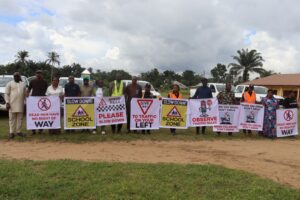
Beyond the training hall, the team took the campaign to the 11-kilometre Owotuta – Nung Oku Ekere – Afaha Udo Eyop – Utuat Market Junction demonstration road spanning Ibesikpo Asutan and Nsit Ibom LGAs. Recently commissioned by Governor Umo Eno, the road became the site of a carnival float and targeted outreach for cyclists, school children, and other road users.
Representing RAAMP National Coordinator, Engr. Aminu Mohammed, FPMU Monitoring and Evaluation Officer, Mr. Chinedu Olisa, called on drivers and residents to strictly follow traffic rules.
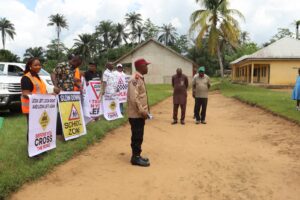
He highlighted that Akwa Ibom’s investment in rural roads is meant to boost transport, commerce, and access to services, but those gains could be lost to preventable accidents. Mr. Olisa praised the state for weaving road safety into school curricula, noting that many students already showed strong knowledge of traffic signs and rules.
Pastor Gideon Akpan, State Project Coordinator of AKS-RAAMP and Director-General of the Rural Access Roads Agency, stated that rising traffic on completed rural roads had made safety planning critical.
He explained that the demonstration road previously recorded fewer than 100 vehicle movements daily before construction, but now sees over 2,000 daily after completion.
“People in the rural communities are not used to speeding traffic. Suddenly, you open the roads and they continue crossing carelessly as if the roads were still untarred. That is why we are beginning to see knockdowns and dangerous accidents,” he added

FPMU Road Safety Consultant, Engr. Okwudili Ikejiani, emphasized proactive road safety audits to cut accidents on rural roads. He warned that road traffic injuries remain a leading cause of death globally, especially among young people, and that rapid infrastructure expansion without safety planning raises crash risks.
According to him, major causes of road accidents include speeding, drunk driving, fatigue, poor vehicle maintenance, bad road conditions, overloading, and weak compliance with traffic regulations.
“The objective of this programme is crash prevention. We want to identify safety concerns while the design is still on paper rather than waiting for crashes to happen,” he said.
Engr. Ikejiani advocated comprehensive road safety checklists from design to completion, covering road signs, zebra crossings, drainage systems, traffic calming measures, pedestrian facilities, road markings, roadside hazards, and protection for vulnerable users like school children, cyclists, and pedestrians.
The exercise also featured safety education sessions by the Akwa Ibom State Command of the Federal Road Safety Corps, led by Superintendent Route Commander Fredrick Lucky Okuono. Posters at the event carried messages including: “Look left, look right, look left again before crossing the road,” “Speed kills, please slow down,” “Slow down, school zone,” “When you drink, don’t drive,” and “Dead men don’t have right of way.”

 has intensified road safety education in Akwa Ibom State to prevent crashes,)